
Best Crops for Polyhouse Farming in Rajasthan: Crop & Water Guide
August 31, 2026
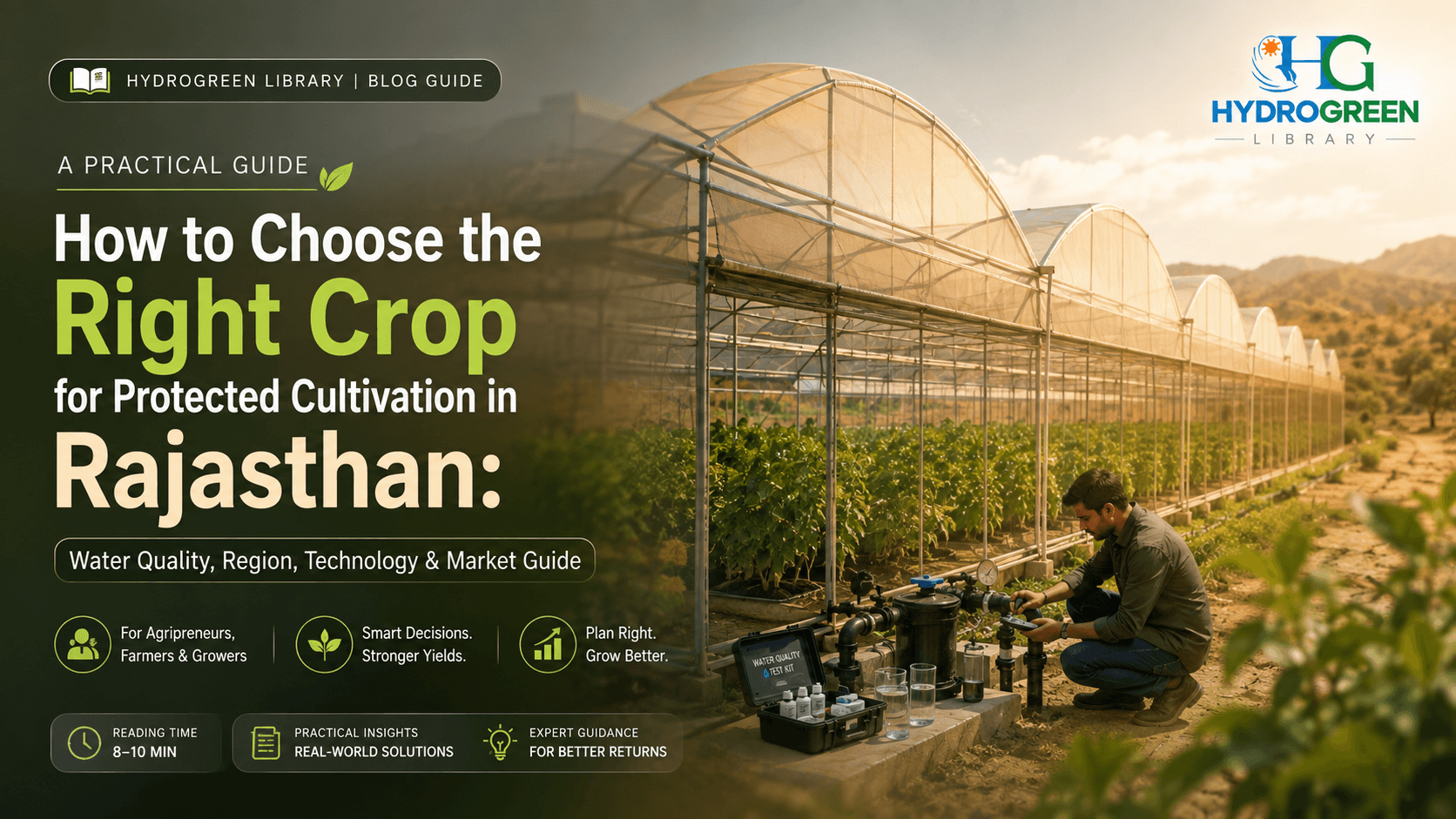
Successful protected cultivation begins long before construction. Learn how Rajasthan's climate, water quality, and regional conditions influence crop selection, and discover a practical framework for planning a productive and sustainable polyhouse project.
INTRODUCTION
Rajasthan is often associated with arid landscapes, limited rainfall and challenging water conditions. Yet the same state also contains regions with canal irrigation, relatively better groundwater availability, stronger horticulture markets and favourable conditions for high-value protected cultivation. This creates an important opportunity—but also an important decision-making challenge. A polyhouse in Rajasthan should not be planned simply because a crop is considered profitable. The right crop depends on the combination of region, water quality, climate, structure, market access, technical capability and production economics.
This is why identifying the best crops for protected cultivation in Rajasthan requires a more scientific approach than simply making a list of popular polyhouse crops. For example, coloured capsicum, cucumber, Dutch rose, lettuce and celery can all be relevant protected-cultivation crops, but their suitability changes with the local environment and the production objective. The central question is therefore not: “Which crop gives the highest price?” It is: “Which crop can perform consistently under my region's climate, water quality, infrastructure and market conditions?”
WHY CROP SELECTION MATTERS MORE IN RAJASTHAN ?
Protected cultivation gives farmers greater control over the crop environment, but it does not eliminate the influence of the surrounding location. The structure can modify temperature, humidity, radiation, wind exposure and pest entry. However, several factors remain fundamental:
💧 Source & Quality of Irrigation Water
☀️ Summer Temperature
❄️ Winter Temperature
💦 Relative Humidity
🚰 Water Availability
⚡ Electricity Reliability
📍 Market Connectivity
👨🌾 Availability of Skilled Labour
🔄 Crop-Cycle Management
📦 Post-Harvest Infrastructure
Rajasthan is particularly interesting because these conditions can change substantially from one region to another. The south-eastern belt, canal-irrigated northern areas, central Rajasthan and the western arid belt should therefore not be treated as one uniform protected-cultivation zone. This regional variation is one of the most important factors in project planning.
WATER QUALITY FOR PROTECTED CULTIVATION: THE FIRST CHECK BEFORE CHOOSING A CROP :
Many farmers begin a polyhouse project by discussing the structure and crop. A better approach is to begin with water testing. This is especially important in Rajasthan, where groundwater quality can vary considerably across locations.
The Central Ground Water Board (CGWB) publishes Rajasthan-specific groundwater-quality and groundwater-resource reports, including the Annual Ground Water Quality Report of Rajasthan 2023–24 and the Groundwater Year Book, Rajasthan 2024–25. These publications demonstrate why local water assessment is more reliable than assuming one statewide water-quality value.
What does TDS mean?
TDS — Total Dissolved Solids — broadly represents the concentration of dissolved substances in water. For protected cultivation, however, TDS should not be treated as the only water-quality parameter. A professional assessment should consider parameters such as:
🧪 TDS
⚡ EC (Electrical Conductivity)
⚗️ pH
💧 Bicarbonates
🧂 Chloride
🔬 Sodium
🦴 Calcium
🧬 Magnesium
🌊 Sulphates
🌱 Boron
💧 Fluoride*
⚙️ Other Parameters
This distinction matters because two water sources can have a similar TDS but behave differently in fertigation because their ionic composition is different.
WHY WATER TESTING SHOULD COME BEFORE CROP SELECTION ?
There is no single TDS number that automatically makes water suitable or unsuitable for every protected crop. Crop tolerance, growing medium, irrigation method, drainage, fertigation strategy and the actual ionic composition of the water all influence suitability. The regional ranges discussed below should therefore be treated as indicative planning ranges derived from the working regional observations in this article, not as official Rajasthan-wide standards. Actual project decisions should always be based on laboratory water analysis.
ICAR-CAZRI's own procurement specifications for water-purification systems illustrate the reality of high-TDS water in arid-zone research environments: its published specifications have considered feed water with TDS values as high as 5,000–8,000 mg/L, depending on the system specification. This is evidence of the need for treatment capability in high-salinity environments, not a recommended irrigation level for crops.
Important sourcing note: The regional TDS ranges used in this blog is indicative working ranges for project-planning discussion. They should not be interpreted as official uniform limits for an entire district or region. The actual borewell, irrigation source, or rainwater harvesting system must be tested and evaluated before finalizing crop selection and fertigation design.n.
Planning a Polyhouse in Rajasthan? Start With Your Water.
A water-quality report can reveal whether your preferred crop and fertigation strategy are technically appropriate for the site. Get a Water-Quality Assessment / Consultation with Hydrogreen to evaluate your water source, crop suitability and protected-cultivation requirements before making a major infrastructure investment.
RAJASTHAN REGION- CROP WISE SUITABILITY GUIDE :
Rajasthan is not a uniform protected-cultivation environment. Climate, groundwater quality, temperature, and local growing conditions can vary significantly from one region to another. Therefore, crop and structure selection should be based on site-specific assessment rather than a single state-wide recommendation.
1. South-East Rajasthan: A Stronger Starting Point for High-Value Crops
South-eastern Rajasthan includes areas influenced by comparatively better rainfall conditions, agricultural activity and, in several locations, more favourable water availability than the western arid belt. The original regional assessment considered areas around Kota, Baran and Jhalawar as particularly interesting for protected cultivation. Where water quality, electricity, market access and farm-level infrastructure are favourable, crops such as:
🌱 Coloured Capsicum
🥒 Cucumber
⭐ Selected Premium Vegetables
🌸 Selected Flowers
The important advantage is not that every farm in this region is automatically suitable. Rather, the region can provide a comparatively stronger combination of water availability, agriculture-market connectivity and climate conditions. For commercial projects, proximity to cities and organized buyers can further influence crop selection.
2. North-West Canal Belt: Water Availability Can Change the Project Equation
The Sri Ganganagar–Hanumangarh belt represents a different agricultural environment because canal irrigation plays an important role in parts of the region. Greater water availability can make protected cultivation more feasible, but water quantity should never be confused with water quality. Canal water and groundwater may have different chemical characteristics, and the quality of a borewell can vary even within relatively small geographical distances. For this region, crops such as cucumber,tomato and coloured capsicum can be considered where the climate, market and water analysis support them. The availability of agricultural infrastructure and established farming activity can also help with labour and market development. However, summer heat remains a critical management factor. A protected structure should therefore be designed around ventilation, irrigation, fertigation and crop-specific environmental management, rather than treating the structure as a simple covered enclosure.
3. Central and Semi-Arid Eastern Rajasthan: Selection Becomes More Technical
Areas around Jaipur, Ajmer and Tonk represent a more mixed situation. The working water-quality assessment used in the original project notes indicates that TDS can commonly fall into a broader range of approximately 500–1,500 ppm, but this should be regarded only as an indicative range—not as a district-wide value. The main lesson is that water testing becomes particularly important before finalizing a crop. For suitable sites, farmers may evaluate:
🌶️ Coloured Capsicum
🥒 Cucumber
🥦 Premium Vegetables
🌸 Selected Flowers
📈 Other High-Value Crops Based on Market Demand
This region also benefits from access to major consumption markets. However, a farmer should calculate market distance, transportation cost, crop perishability and buyer requirements before finalizing the crop.A technically excellent polyhouse can still underperform commercially if the crop is produced without a reliable market channel.
4. Western Arid Rajasthan: Protected Cultivation Requires a Different Strategy
Western Rajasthan includes areas such as Jaisalmer, Barmer, Bikaner, Phalodi and Jodhpur, where low rainfall and high climatic stress make water management central to agricultural planning. The original notes identify rainfall in some western districts at approximately 100–350 mm annually. Because rainfall varies by location and year, such figures should be treated as broad regional context rather than a precise site-specific statistic. The major issue here is not simply whether a polyhouse can physically be installed. The question is whether the complete system can maintain the required production environment economically.
This includes:
🚰 Reliable Water Source
💧 Water-Quality Management
💦 Efficient Irrigation
🧪 Fertigation Control
🌬️ Cooling & Ventilation
🌡️ Heat Management
🚿 Drainage
⚡ Electricity
🔧 Maintenance
📦 Market Accesss
In high-salinity locations, crop selection must be particularly conservative. A high-value crop should not be selected simply because its market price looks attractive. Water treatment, growing media, drainage and fertigation strategy may become major components of project economics.
Important Water-Quality Note :
The EC ranges discussed in regional project planning should be treated as indicative observations rather than official uniform limits for individual Rajasthan regions. Groundwater quality can vary considerably even between nearby locations. Also, EC and TDS are related but are not interchangeable measurements. A proper laboratory water analysis should assess parameters relevant to protected cultivation before the project is designed.For location-specific groundwater information, farmers and project planners should consult relevant Central Ground Water Board (CGWB) groundwater-quality publications along with an actual site-specific water test. The right approach is simple: test the water first, understand the site, and then select the crop and protected-cultivation system. This reduces the risk of designing a technically suitable structure around an unsuitable water source.
WHICH CROPS SHOULD BE CONSIDERED FOR PROTECTED CULTIVATION IN RAJASTHAN?
Coloured Capsicum -
Coloured capsicum is one of the strongest candidates for commercial protected cultivation because quality, uniformity and appearance can influence market value.However, it is also a crop that demands disciplined environmental and crop management. Important considerations include:
🌱 Quality Seedlings
🪴 Suitable Planting Media / Soil Preparation
💧 Drip Irrigation
🧪 Fertigation
🪢 Plant Training & Support
✂️ Pruning
🔍 Pest Monitoring
🌡️ Temperature Management
For Rajasthan, the most important preliminary checks are water quality, summer temperature management and market access.
Cucumber -
Cucumber can be attractive because of its relatively fast crop cycle and established demand..Protected cultivation can provide better control over crop environment and production quality compared with open-field cultivation. The project should still account for:
🌱 Variety Selection
📐 Planting Density
🪢 Trellising
💧 Irrigation Frequency
🧪 Fertigation
💦 Humidity Management
🐝 Pollination Requirements — Depending on Variety
🔍 Pest & Disease Monitoring
🧺 Regular Harvesting
Cucumber can therefore be a useful option where a farmer wants a crop with comparatively faster production cycles and has access to an appropriate market.
Dutch Rose and Premium Flowers -
Protected flower cultivation can offer an alternative to vegetable production in suitable locations. Dutch rose is particularly dependent on environmental management, crop quality and market linkage. Flower projects require careful consideration of:
🌱 Variety
🌡️ Temperature
💦 Humidity
☀️ Light
💧 Irrigation
🧪 Nutrition
🌿 Plant Architecture
🧺 Harvesting Stage
📊 Grading
📦 Packaging
❄️ Cold-Chain / Post-Harvest Handling — Where Required
The crop should therefore be selected only after studying the target market. A premium flower without a reliable buyer network can create a higher commercial risk than a less glamorous crop with stronger demand.
Tomato -
Tomato can be a suitable protected-cultivation crop in Rajasthan when the variety, planting window, structure and climate-management system are selected according to local conditions. Polyhouse cultivation can help protect the crop from extreme weather and provide a more controlled growing environment.
Its suitability depends strongly on:
🌡️ Temperature & Seasonal Conditions
🌱 Variety Selection
💧 Water Quality & Availability
🌬️ Ventilation & Temperature Management
🔄 Crop-Cycle Planning
📈 Market Demand & Selling Price
📦 Post-Harvest Handling
WHY CROP REQUIREMENTS SHOULD GUIDE STRUCTURAL DESIGN?
One of the most common project-planning mistakes is selecting the structure first and the crop later. The correct sequence is closer to:
Region → Water → Market → Crop → Climate Requirement → Structure → Irrigation/Fertigation → Economics
For example, a crop requiring tighter temperature and humidity control may need a different infrastructure strategy from a crop that can perform effectively under a naturally ventilated polyhouse.
The current MIDH Operational Guidelines 2025 recognize protected cultivation as an important horticultural intervention and cover components such as greenhouses, shade-net houses, rain shelters and plastic tunnels. The guidelines also state that irrigation systems are included within the protected-cultivation cost framework and emphasize conformity with applicable BIS standards for assisted structures. This reinforces an important project principle: Protected cultivation is a system, not just a structure.
THE ECONOMICS: REVENUE IS NOT PROFIT -
A crop may have a high selling price and still produce an unattractive business outcome. The financial model should consider:
🏗️ Structure Cost
💧 Irrigation & Fertigation
🌱 Planting Material
🪴 Growing Media
🧪 Fertilizers
🛡️ Crop Protection
👨🌾 Labour
⚡ Electricity
🚰 Water Treatment — Where Required
🔧 Repairs & Maintenance
📦 Packaging
🚚 Transportation
💰 Market Commissions / Other Selling Costs
📉 Crop Losses
🔄 Replacement Costs
Therefore: Revenue ≠ Profit The final crop-selection decision should be based on expected production performance and realistic operating costs—not only the market price. Farmers and investors should also test the project under different scenarios: What happens if yield is lower than expected? What happens if the selling price falls? What happens if water-treatment costs increase? This type of sensitivity analysis is more useful than relying on a single optimistic ROI estimate.
GOVERNMENT SUPPORT AND SUBSIDY: PLAN CAREFULLY
Protected cultivation may be supported under applicable government horticulture programmes, including components implemented through MIDH/NHM and other relevant schemes, depending on the project, location, beneficiary eligibility, technical specifications and prevailing guidelines. The current MIDH framework specifically includes protected-cultivation components such as greenhouses and shade-net houses. However, subsidy should never be treated as automatic. Before planning around financial asistance, the applicant should verify:
📋 Current Scheme
✅ Eligibility
🧩 Applicable Component
📐 Technical Standards
💰 Cost Norms
📄 Documentation
🔄 Approval Process
📊 DPR Requirements
🔍 Inspection Requirements
🏛️ Implementing Authority
📍 Current State-Level Procedures
NHB's current website also lists revised scheme guidelines, applicable cost norms and recent modifications to MIDH/NHB schemes, demonstrating why applicants should work from the latest applicable guidelines rather than old subsidy information circulated online.
GET THE RAJASTHAN CROP & PROTECTED CULTIVATION PLANNING CHECKLIST :
Before finalizing a polyhouse or greenhouse project, evaluate these ten factors:
1. Test the water
Do not rely on a TDS meter alone. Obtain a proper laboratory water analysis.
2. Identify the crop-market connection
Know who will buy the crop before planting it.
3. Evaluate summer conditions
Rajasthan's heat load can materially affect crop performance and infrastructure requirements.
4. Select the structure according to the crop
Do not use the same structure specification for every crop.
5. Plan irrigation and fertigation
Water efficiency and nutrient precision are fundamental to commercial protected cultivation.
6. Evaluate electricity reliability
Cooling, pumping, fertigation and other systems may depend on consistent power.
7. Consider labour capability
Protected cultivation requires more disciplined crop management than simply installing a structure.
8. Build post-harvest planning into the DPR
Harvesting is not the end of the business process.
9. Prepare a realistic financial model
Calculate costs, revenue, operating expenses and downside scenarios.
10. Take professional technical advice before construction
A site assessment can identify constraints that may otherwise become expensive after installation.
KEY FACTORS TO EVALUATE BEFORE STARTING PROTECTED CULTIVATION IN RAJASTHAN :
Choosing the right crop should not depend on guesswork. Hydrogreen's Rajasthan Protected Cultivation Crop-Selection Checklist can be used as a practical planning document covering:
📍 Region
🚰 Water Source
💧 Water Quality
🌱 Crop Suitability
🏗️ Structure Requirement
📈 Market Access
💦 Irrigation & Fertigation
💰 Investment Considerations
⚠️ Major Project Risks
Contact HYDROGREEN to receive the checklist and use it as a starting point for your project discussion.
HOW HYDROGREEN CAN HELP ?
HYDROGREEN HAS SUCCESSFULLY DELIVERED PROTECTED CULTIVATION PROJECTS ACROSS RAJASTHAN, SUPPORTING FARMERS AND AGRIPRENEURS IN BUILDING PRODUCTIVE AND COMMERCIAL FARMING SYSTEMS.
PROJECT PLANNING & ASSESSMENT
Every project begins with an assessment of the location, water quality, climate, proposed crop, investment capacity and market potential. This helps ensure that the right crop, structure and production system are selected for the farm.
COMPLETE POLYHOUSE PROJECT SUPPORT
Hydrogreen provides end-to-end support for protected cultivation projects, from technical planning and structure selection to project execution, helping farmers establish a system suited to their crop and local conditions.
AGRONOMIC SUPPORT
Hydrogreen’s support continues beyond polyhouse installation. Farmers receive expert agronomic guidance related to crop planning, irrigation, fertigation, plant management, pest and disease management and other important cultivation practices.
FIRST CROP CULTIVATION SUPPORT
For farmers starting protected cultivation for the first time, Hydrogreen provides guidance during the first crop cycle, helping them understand cultivation practices, crop scheduling, plant management and other critical operational requirements.
ONE YEAR OF EXPERT SUPPORT
Hydrogreen provides structured technical and agronomic support during the first year of project operation, helping farmers make informed decisions throughout the crop cycle and build confidence in protected cultivation.
MARKET & COMMERCIAL SUPPORT
Producing a quality crop is only one part of a successful project. Hydrogreen also focuses on market-oriented planning and provides guidance related to market opportunities, buyer requirements, harvesting and post-harvest commercial planning wherever applicable.
FOCUS ON FARMER PROFITABILITY
The objective is not simply to construct a polyhouse. The objective is to develop a commercially viable protected cultivation project where proper crop selection, scientific cultivation, expert support and market planning work together to improve the potential for profitable returns.
SUCCESSFUL PROJECTS ACROSS RAJASTHAN
Hydrogreen has successfully executed and supported multiple protected cultivation projects across the Rajasthan region. These projects demonstrate how scientifically planned polyhouse farming, combined with proper agronomic management and market-oriented cultivation, can help farmers move towards commercially successful farming.
🧑🌾 Productive Crop Cycles
Farmers can achieve productive crop cycles and commercial returns when projects are planned around local water, climate, crop and market conditions
💼 Polyhouse as a Business
Successful projects demonstrate that a polyhouse can become a productive agricultural business—not simply an infrastructure investment.
🌱 Scientific Crop Management
Proper crop selection, scientific cultivation, efficient irrigation and fertigation, and timely expert guidance can improve the potential for profitable production.
👨🔬 Continued Expert Support
Hydrogreen’s post-installation support helps farmers manage their initial crop cycles with expert guidance rather than being left on their own after construction.
🔗 Complete Farming System
.The focus remains on building a complete farming system that connects project planning, polyhouse infrastructure, crop cultivation, agronomy and market planning. Book a Free Site Assessment -If you are planning protected cultivation in Rajasthan, do not begin with the question, “Which polyhouse should I buy?” Begin with: What can my land, water, climate and market realistically support?Hydrogreen can help evaluate these factors through a structured site and project assessment.
PLAN YOUR SUCCESSFUL PROTECTED CULTIVATION PROJECT WITH HYDROGREEN
Planning a polyhouse or protected cultivation project in Rajasthan? DON’T START WITH THE STRUCTURE. START WITH THE RIGHT PROJECT PLAN. Share your location, water report, proposed crop, investment objective and target market with the Hydrogreen team. Our experts can help assess your project requirements and guide you towards the right crop, structure, cultivation strategy and commercial approach.
PROJECT PLANNING → POLYHOUSE EXECUTION → FIRST CROP → AGRONOMIC SUPPORT → MARKET GUIDANCE
BOOK YOUR PROJECT ASSESSMENT TODAY :
CONTACT THE HYDROGREEN TEAM FOR SUCCESSFUL PROJECT PLANNING
Frequently Asked Questions
Q1. Which are the best crops for protected cultivation in Rajasthan?
Potential crops include coloured capsicum, cucumber, Dutch rose, Tomato on the actual water chemistry, crop, growing system and treatment strategy.
Q3. Which Rajasthan region is best for protected cultivation?
There is no single best region for every crop. South-eastern Rajasthan and parts of the canal-irrigated north-west can offer favourable conditions for certain projects, while central and western regions may require more careful water and climate management.
Q4. Can protected cultivation be successful in western Rajasthan?
Yes, but project planning becomes more demanding because of water scarcity, possible salinity, high temperatures and low rainfall. Water quality, climate management, irrigation efficiency and economics should be evaluated before investment.
Q5. Is subsidy available for polyhouse farming in Rajasthan?
Protected cultivation can fall under applicable government horticulture-support programmes, including relevant MIDH/NHB components, subject to current guidelines, eligibility and technical requirements. Subsidy should never be assumed or treated as guaranteed.
CONCLUSION: IN RAJASTHAN, THE RIGHT CROP STARTS WITH THE RIGHT DIAGNOSIS
Protected cultivation can create opportunities for high-value horticulture in Rajasthan, but the structure itself does not determine success.The stronger approach is to connect:
Region + Water + Crop + Structure + Technology + Market + Economics
A crop that performs well in one Rajasthan district may not be the right choice for another location. Similarly, a water source that appears acceptable from a simple TDS reading may require further analysis before being used for intensive fertigation. This is why the best crops for protected cultivation in Rajasthan should be identified through site-specific evaluation rather than a generic crop list. Modern protected cultivation is ultimately about designing the right production environment around the crop. For farmers and investors, that means making the technical diagnosis before making the infrastructure investment. For Hydrogreen, the objective is to help turn that diagnosis into a technically planned, agriculturally informed and execution-ready project.
Author Vision ~
“Future-ready agriculture begins with better decisions before better infrastructure. When farmers understand their water, climate, crop and market as one connected system, protected cultivation becomes not just a structure—but a smarter way to manage agricultural resources and investment.”