
Crops Suitable For Polyhouse Farming In India: A Practical Guide
August 20, 2026
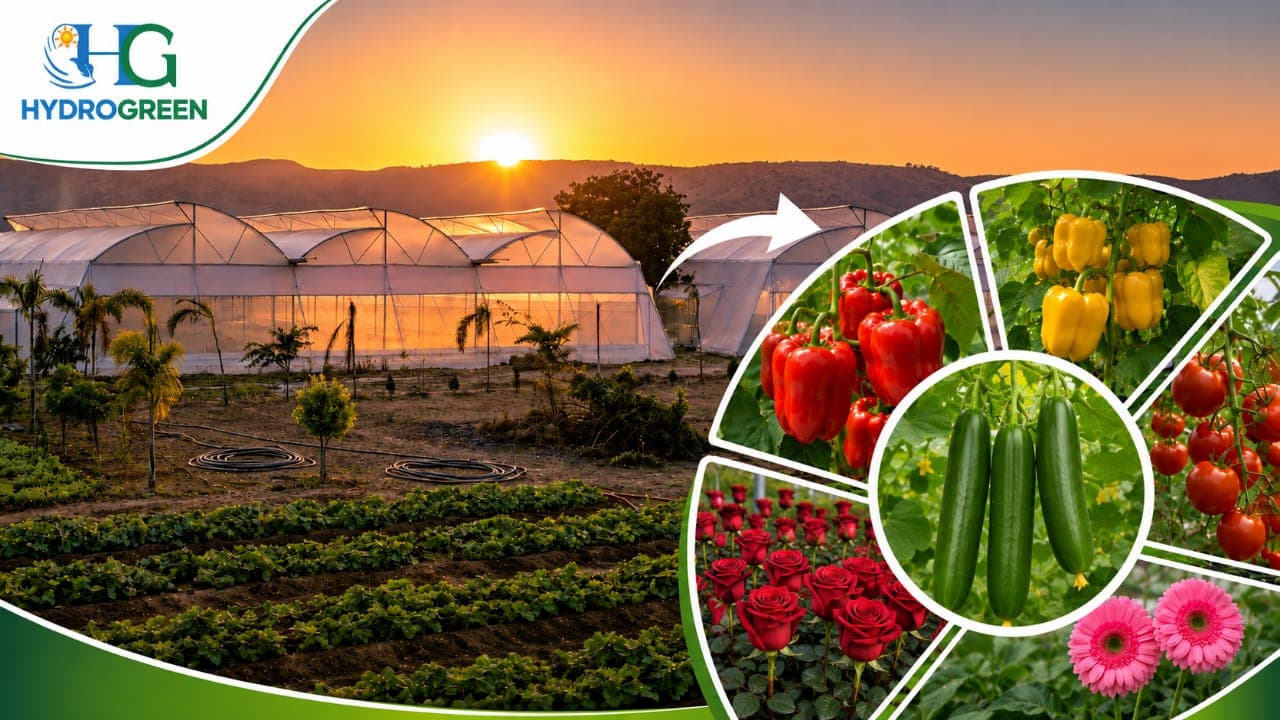
Discover the crops suitable for polyhouse farming in India, including vegetables, flowers and fruit crops, and learn how climate, structure, crop type, irrigation and market demand influence crop selection.
Introduction
Choosing the right crop is one of the most important decisions before investing in a polyhouse. A polyhouse can provide a more controlled growing environment than open-field cultivation, but the structure itself does not guarantee better production or profitability. Crop selection has to match the polyhouse design, local climate, water quality, growing system, technical capability, production season and market opportunity.This is why the question is not simply, “Which crop grows best inside a polyhouse?” The more useful question is:
Which crop is suitable for this particular polyhouse, location, season and market?
Protected cultivation has become an important approach for producing high-value horticultural crops in India. ICAR notes that protected cultivation has been standardized for quality production of various vegetables and ornamental plants, with benefits associated with productivity, quality and economic viability.
Recent ICAR literature also identifies several crops suitable for protected cultivation, including tomato, cherry tomato, cucumber, capsicum, bitter gourd, musk melon, summer squash, Rose, Gerbera, Lilium, Tulip, Anthurium, Carnations, Orchids, Chrysanthemum and strawberry. However, suitability varies from one farm to another.
This guide explains the major crops suitable for polyhouse farming, what makes them appropriate for protected conditions and what farmers should consider before selecting one.
Which Crops Are Suitable for Polyhouse Farming?
Some of the commonly considered crops for polyhouse and other protected cultivation systems include:
Vegetable Crops
- Tomato
- Cherry Tomato
- Capsicum
- Cucumber
- Bitter Gourd
- Musk Melon
- Summer Squash
- Broccoli
Flower Crops
- Gerbera
- Rose
- Lilium
- Tulip
- Anthurium
- Carnations
- Orchids
- Chrysanthemum
Fruit Crops
- Strawberry
- Papaya
- Fruit nursery plants
- Vegetable nursery plants
The right selection depends on the crop's environmental requirements, structure type, planting material, production cycle and market demand. A recent ICAR article specifically describes capsicum, tomato and parthenocarpic cucumber as high-value crops widely suited to protected cultivation.
Why Crop Selection Matters in Polyhouse Farming ?
A polyhouse changes the production environment, but every crop responds differently to temperature, humidity, light, ventilation, irrigation and nutrition.
For example, a crop that performs well under a naturally ventilated structure may require a more controlled environment in another climatic region. Similarly, a crop selected for off-season production may offer an opportunity only if the farmer has access to a suitable market.
Crop selection therefore affects:
- Production planning
- Structure utilization
- Water and nutrient requirements
- Labour requirements
- Crop duration
- Pest and disease management
- Harvest frequency
- Market timing
- Investment recovery
- Overall project economics
NHB's protected-cultivation resources cover a wide range of vegetable production practices, including planting, irrigation, fertilisation, pest management and harvesting, demonstrating that crop-specific management remains central to protected cultivation.
1. Tomato
Tomato is one of the most established vegetable crops for protected cultivation.
Under a properly designed polyhouse, indeterminate tomato plants can be trained vertically, allowing growers to make better use of available growing space. Protected conditions can also support production during periods when open-field conditions are less favourable.
Tomato production under protected conditions requires attention to:
- Variety or hybrid selection
- Plant training and pruning
- Irrigation and fertigation
- Temperature and humidity management
- Pollination and fruit setting
- Pest and disease monitoring
- Harvest scheduling
ICAR-IIVR has documented practical examples of tomato cultivation in naturally ventilated polyhouses and has highlighted the importance of technical management, including training, pruning and irrigation.
Best suited for: Growers with access to technical support and markets that can absorb regular, quality produce.
2. Cherry Tomato
Cherry Tomato is another high-value crop considered suitable for protected cultivation.
Its relatively premium positioning can make it attractive for markets such as modern retail, hotels, restaurants and direct-to-consumer channels. However, the commercial success of cherry tomato depends heavily on market positioning and consistent quality.
The crop should not be selected merely because its market price can be higher than conventional tomato. Farmers should first evaluate:
- Local demand
- Buyer requirements
- Packaging requirements
- Harvest frequency
- Seed cost
- Expected market price
- Distance to market
ICAR's recent protected-cultivation literature lists cherry tomato among high-value crops suited to protected structures.
3. Capsicum
Capsicum is among the most important crops associated with commercial polyhouse farming in India. Coloured capsicum, particularly red and yellow types, can benefit from controlled production environments and premium market channels.
ICAR has documented successful coloured capsicum production in a 3,000 sq. m polyhouse in Maharashtra. The case demonstrates that crop performance is influenced not only by the structure but also by irrigation, technical training and strong market linkages. Capsicum production requires careful management of:
- Temperature
- Irrigation
- Fertigation
- Root-zone conditions
- Plant support
- Pest and disease pressure
- Fruit quality
- Harvest timing
The lesson for growers is important: a high-value crop still needs a high-quality production and marketing plan.
4. Cucumber
Cucumber is particularly relevant for protected cultivation because suitable cucumber types can be managed effectively under controlled growing conditions.
Parthenocarpic cucumber is frequently associated with protected cultivation because fruit development does not depend on conventional pollination in the same way as standard cucumber types.
ICAR's recent work identifies parthenocarpic cucumber as one of the high-value crops widely suited to protected structures.
Cucumber can also be attractive where the farmer wants to plan relatively shorter production cycles and improve the utilization of the protected structure. Important considerations include:
- Suitable hybrid selection
- Trellising
- Irrigation
- Fertigation
- Humidity management
- Disease prevention
- Harvest frequency
- Crop rotation
5. Bitter Gourd
Bitter Gourd belongs to the cucurbit group and can be cultivated under protected conditions where the structure and production system are appropriate.
As a vine crop, it requires effective support and canopy management. The grower must also consider pollination requirements, disease management and ventilation.
Bitter Gourd is included among the major horticultural crops identified for polyhouse-based farming systems in protected-cultivation literature.
Its suitability should therefore be evaluated based on the local production environment and expected market demand rather than assuming that every cucurbit is equally suitable for every polyhouse.
6. Musk Melon
Musk Melon can be considered for protected cultivation, particularly where growers are targeting specific production windows or higher-quality fruit. Protected structures can help reduce exposure to adverse weather conditions and allow closer management of the crop environment.
ICAR material has also highlighted protected cultivation of muskmelon during winter as an avenue for commercial production. However, successful production depends on:
- Temperature management
- Pollination strategy
- Plant spacing
- Trellising or support where applicable
- Fruit load management
- Irrigation
- Nutrition
- Market timing
7. Summer Squash
Summer Squash is another cucurbit that can be considered under protected cultivation. Crop suitability depends on the selected variety, local climate and structure. As with other cucurbits, environmental management and pollination need to be considered during planning.
ICAR agro-advisories have identified specific summer squash varieties for cultivation and also emphasize the role of healthy nursery production through polybags or plug trays for cucurbit crops.
8. Broccoli
Broccoli can be cultivated under protected structures in suitable climatic conditions. ICAR has documented farmers growing broccoli along with tomato, capsicum and cucumber under shadenet houses/polyhouses in Madhya Pradesh. For broccoli, the crop calendar becomes particularly important. Protected cultivation should be used to create a production window that matches the crop's environmental requirements and the intended market.
Flower Crops Suitable for Polyhouse Farming
Polyhouses are not limited to vegetables. Floriculture is one of the important applications of protected cultivation. NHB's technical standards describe polyhouses as structures used for floriculture, vegetables and nurseries, while ICAR reports standardized protected-cultivation technologies for vegetables and ornamental plants.
Gerbera
Gerbera is a major commercial flower crop associated with protected floriculture. It is grown for cut flowers and can be suitable where growers have access to organized flower markets. Important considerations include:
- Temperature
- Humidity
- Root-zone management
- Irrigation
- Fertigation
- Flower quality
- Post-harvest handling
- Market access
ICAR has documented Gerbera cultivation under protected structures among farmers adopting high-tech horticulture.
Rose
Rose is another important protected floriculture crop. Protected production can be useful for growers targeting consistent flower quality and specific market requirements. The economics of Rose cultivation, however, depend strongly on cultivar selection, structure investment, labour, post-harvest handling and market linkage.
Lilium
Lilium can be considered where the grower has suitable technical conditions and a market for premium flowers.
Tulip
Tulip is a specialized flower crop with specific environmental requirements. It should therefore be considered only after evaluating the local climate and the level of environmental control available.
Anthurium
Anthurium is another ornamental crop that can be grown under protected conditions, particularly where environmental requirements can be managed appropriately.
Carnations
Carnations are commercially important cut flowers and can form part of a protected floriculture project where suitable climatic and market conditions exist.
Orchids
Orchids have specialized environmental requirements and therefore need careful planning of structure, humidity, temperature, planting material and market.
Chrysanthemum
Chrysanthemum can also be included in protected floriculture systems depending on the production objective and local market.
ICAR's horticultural research programmes include floriculture and ornamental crops as important areas of protected cultivation research.
Fruit Crops and Nursery Applications
- Protected cultivation can also extend beyond conventional vegetable and flower production. Recent literature identifies Strawberry and Papaya, along with fruit-nursery propagation and hardening, among horticultural applications associated with protected farming systems.
- Nursery production is particularly relevant because protected structures can provide a controlled environment for raising healthy planting material.
- ICAR has also identified nursery raising of crops such as cauliflower, cabbage, brinjal, tomato and chilli as an important horticultural activity. For commercial nursery projects, the objective is not simply to grow plants under a roof. It is to produce uniform, healthy and marketable planting material through appropriate sanitation, growing media, irrigation and environmental management.
How to Choose the Right Crop for Your Polyhouse ?
There is no single crop that can be considered the “most profitable” for every polyhouse project. The right choice depends on how well the crop matches the local climate, polyhouse structure, water availability, production requirements, market demand and overall project economics.
Before finalizing a crop, farmers and project planners should evaluate the following factors:
- Climate: Consider the temperature, humidity, rainfall pattern and seasonal conditions of the location. The selected crop should be compatible with the environmental conditions that can be maintained inside the polyhouse.
- Polyhouse Type: Determine whether the project uses a naturally ventilated polyhouse or a climate-controlled structure. Different crops have different levels of environmental-control requirements.
- Water: Assess the availability and quality of irrigation water, including parameters such as pH and salinity. Water quality can directly influence crop growth and nutrient management.
- Crop Requirements: Understand the crop’s temperature, humidity, light, spacing, irrigation and nutritional requirements before selecting it.
- Planting Material: Select a suitable variety or hybrid that is appropriate for protected cultivation and the intended production conditions.
- Production Cycle: Consider the crop duration, harvesting period and whether crop rotation can be incorporated into the production plan to improve the utilization of the polyhouse.
- Market: Evaluate where the produce will be sold—local markets, wholesale markets, retailers, institutional buyers or contract buyers. A crop should have a realistic and accessible market before commercial cultivation begins.
- Labour: Consider the availability of trained labour for activities such as planting, training, pruning, fertigation, pest monitoring and harvesting.
- Infrastructure: Check whether the project has the necessary irrigation, fertigation, crop-support, drainage and other infrastructure required for the selected crop.
- Economics: Evaluate the complete financial picture, including planting material, inputs, labour, infrastructure and operating costs, along with expected market realization and potential production risks. A crop with a higher selling price is not necessarily more economically suitable if its production costs and market risks are also high.
Why Market Should Influence Crop Selection ?
A technically successful crop is not automatically a commercially successful crop. Before planting, growers should answer: Who will buy the produce?Potential channels may include:
- Local wholesale markets
- Retailers
- Supermarkets
- Hotels and restaurants
- Institutional buyers
- Processors
- Direct consumers
- Contract buyers
ICAR's documented coloured-capsicum case illustrates this principle. The farmer developed market connections with larger urban markets and strengthened collective procurement and marketing arrangements alongside production improvements. Therefore, market planning should begin before planting, not after harvesting.
Common Mistakes When Selecting Polyhouse Crops
1. Selecting a crop only because its price is high
Market prices change. A crop should be evaluated on its production cost, crop duration, quality requirements, demand and market risk.
2. Choosing the crop before evaluating the site
Climate and water quality can significantly influence crop suitability.
3. Using unsuitable varieties
Protected cultivation often requires varieties or hybrids suited to the intended growing environment.
4. Ignoring technical management
Training, pruning, irrigation, fertigation, sanitation and environmental management can determine whether the crop performs as expected.
5. Building the structure without a crop plan
The structure, irrigation system and environmental controls should support the selected crop.
6. Ignoring market linkage
Production without a realistic sales strategy can weaken project economics.
Hydrogreen Expert Insight: Crop Selection Is a Project Decision
From a protected-cultivation perspective, selecting a crop should never be treated as an isolated farming decision. A commercial polyhouse project works as a system:
Crop → Climate → Structure → Irrigation → Fertigation → Environmental Management → Labour → Market → Economics
For instance, a farmer considering capsicum needs more than planting material. The project must account for suitable structural design, crop support, irrigation and fertigation, environmental conditions, crop management, harvesting and market linkage.
This integrated approach is especially important because protected cultivation involves higher initial investment and requires skilled management. Recent ICAR research also emphasizes the importance of location-specific designs, suitable hybrids and crop-specific production practices for sustainable protected cultivation. The objective should therefore be controlled production with commercial discipline, not simply cultivation inside a protected structure.
How Hydrogreen Can Help ?
Hydrogreen approaches protected cultivation as an integrated agricultural infrastructure project rather than only a structural installation. For growers evaluating crops suitable for polyhouse farming, the planning process can be aligned around the intended crop, local climate, available land, irrigation requirements, production objectives and market opportunity.
Hydrogreen's protected-cultivation approach can be relevant to projects involving:
- Polyhouse structures
- Greenhouse infrastructure
- Net houses
- Irrigation and fertigation systems
- Crop-oriented project planning
- Protected cultivation infrastructure
- Agronomic support
- Commercial horticulture projects
The important principle is simple: the crop should influence the project design, and the project design should support the crop. If you are planning a protected cultivation project, evaluating the crop before finalizing the structure can help create a more practical and technically aligned farming system.
Which Crop Should I Choose?
- If you are a beginner: Start with Cucumber or suitable Tomato varieties, as they can be considered relatively practical options for growers building experience in protected cultivation.
- If you want premium vegetables: Consider Coloured Capsicum or Cherry Tomato, particularly when suitable production conditions and market demand are available.
- If you have strong technical expertise: Consider Floriculture crops, such as Gerbera, Rose or other suitable flowers, where specialised crop and environmental management is possible.
- If you have access to a premium urban market: Cherry Tomato, Coloured Capsicum or high-value flowers may be considered when consistent quality, supply and buyer requirements can be managed.
- If your business focuses on planting material: Nursery production can be a suitable option, especially where there is demand for healthy and uniform vegetable, flower or fruit planting material.
- If your location has specific climate limitations: Do not select a crop based on popularity alone; first assess the local climate, water quality, polyhouse type and environmental-control requirements before finalising the crop.
Frequently Asked Questions
1. Which crops are best suited for polyhouse farming?
Commonly considered crops include Tomato, Cherry Tomato, Capsicum, Cucumber, Bitter Gourd, Musk Melon, Summer Squash and Broccoli. Flower crops such as Gerbera and Rose are also important protected-cultivation options. Suitability depends on climate, structure, market and crop management capability.
2. Is Cucumber suitable for polyhouse farming?
Yes. Cucumber, particularly suitable parthenocarpic types, is widely considered for protected cultivation. Crop selection should be matched with the structure, season, irrigation system and target market.
3. Can Capsicum be grown in a polyhouse?
Yes. Capsicum is one of the important high-value vegetable crops cultivated under protected conditions. ICAR has documented successful coloured-capsicum production in a polyhouse in Maharashtra.
4. Which flower crops can be grown in a polyhouse?
Important protected floriculture crops include Gerbera, Rose, Lilium, Tulip, Anthurium, Carnations, Orchids and Chrysanthemum, depending on the local climate, structure and market.
5. Can Tomato be grown throughout the year in a polyhouse?
Protected cultivation can extend or shift the tomato production window by reducing exposure to certain external weather conditions. However, year-round production still requires appropriate crop planning and environmental management rather than relying on the structure alone.
6. Is every crop suitable for every polyhouse?
No. A naturally ventilated polyhouse and a highly climate-controlled greenhouse do not provide the same level of environmental control. Crop selection should therefore consider structure type, climate and crop requirements.
7. How do I choose a crop for my polyhouse?
Evaluate climate, water quality, structure type, variety, crop duration, technical requirements, labour, market demand, investment and expected production economics before making the decision.
Conclusion
The crops suitable for polyhouse farming extend across vegetables, flowers, fruits and nursery applications. Tomato, Cherry Tomato, Capsicum, Cucumber, Bitter Gourd, Musk Melon, Summer Squash and Broccoli are among the vegetable crops that can be considered, while Gerbera, Rose and other high-value flowers provide opportunities in protected floriculture. But there is no single crop that is automatically the best choice for every farmer.
The stronger approach is to match crop requirements with climate, polyhouse design, irrigation, fertigation, technical capability and market demand. Protected cultivation works best when the structure and crop are planned as one system. For a farmer or agribusiness investor, the most important question is therefore not simply :
“What can I grow in a polyhouse?” but:
“Which crop makes the most technical and commercial sense for my specific project?”
Sources & References
ICAR – Indian Council of Agricultural Research: Protected cultivation and horticultural science resources.
ICAR – Suitable horticultural crops for polyhouse farming and seasonal rotations: Indian Farming / ICAR e-Publication.
ICAR – Protected cultivation of high-value vegetable crops: Indian Farming, August 2025.
ICAR-IIVR – Technology and technical support for protected vegetable cultivation.
ICAR – Coloured Capsicum Polyhouse Success Story.
National Horticulture Board – Protected Cultivation of Vegetable Crops.
National Horticulture Board – Technical Standards for Poly House and Net House.
~TANYA TOMAR
Protected Cultivation Expert
Vision: To make crop selection for protected cultivation more practical and knowledge-driven, helping growers connect scientific crop planning with suitable infrastructure and real market opportunities.