
Essential Components Of A Modern Polyhouse
August 20, 2026
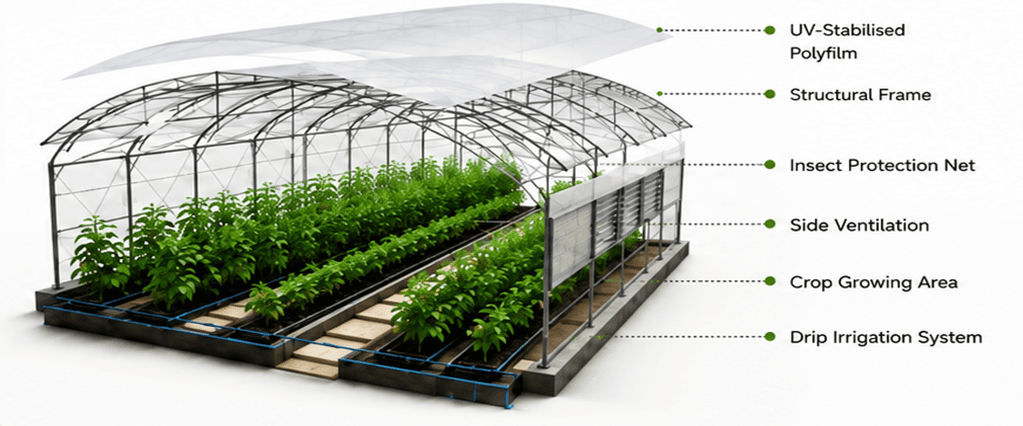
A modern polyhouse is an integrated growing system made up of structural, irrigation, ventilation, fertigation, climate-control and monitoring components. Understanding these essential polyhouse components helps farmers choose the right setup for their crop, climate and production goals.
A modern polyhouse is much more than a steel frame covered with plastic. Its performance depends on how well the structure, covering, ventilation, irrigation, fertigation, environmental control and monitoring systems work together.
For farmers and agri-entrepreneurs planning protected cultivation, understanding these components before investing is important. A strong structure without proper ventilation can create excessive heat. An efficient irrigation system without filtration and fertigation management can lead to uneven crop growth. Similarly, an expensive climate-control system may not be appropriate for every crop or location.
In other words, a polyhouse should be designed as an integrated production system—not simply as a protected structure.
This guide explains the major polyhouse components, their functions, and the factors that should be considered when planning a modern protected cultivation project in India.
What Are the Main Components of a Polyhouse?
The major components of a modern polyhouse generally include:
- Foundation and structural framework
- Polyethylene or other suitable cladding
- Ventilation system
- Insect-proof screening
- Shading and thermal-control arrangements
- Cooling and, where required, heating systems
- Drip irrigation system
- Fertigation and filtration system
- Drainage and water-management infrastructure
- Electrical and power systems
- Sensors and climate-monitoring equipment
- Automation and control systems
- Crop-support and cultivation infrastructure
- Access, pathways and operational facilities
The exact configuration depends on the crop, climate, location, scale, production objective and level of environmental control required.
1. Structural Framework: The Backbone of the Polyhouse
The structural framework carries the covering and transfers environmental loads safely to the foundation.
Typical structural elements include:
- Columns
- Arches or trusses
- Purlins
- Bracing members
- Gutter and ridge components
- Curtain pipes
- Cross bracing
- Foundation connections
For commercial protected cultivation, galvanized tubular structures are commonly used because structural durability is critical to the long-term performance of the facility.
NHB's technical standards specify hot-dip galvanized tubular structures for naturally ventilated polyhouses and provide technical specifications for structural members and stability. The standards also emphasize designing structures according to wind conditions.
Why the structure matters ?
A well-designed structure should:
- Remain stable under expected environmental loads
- Support the cladding securely
- Provide sufficient internal height and usable crop space
- Allow installation of irrigation, ventilation and crop-support systems
- Facilitate maintenance and replacement of components
The structural design should therefore be based on site conditions and crop requirements, rather than simply selecting the cheapest available framework.
2. Foundation and Anchoring System
The foundation connects the polyhouse structure to the ground.
Its purpose is to provide stability against:
- Wind forces
- Structural loads
- Movement or overturning
- Long-term operational stresses
Foundation design should consider soil conditions, structural design, drainage and local environmental conditions.
This is one area where cost-cutting can become expensive later. A weak foundation can compromise the stability of the entire protected structure.
NHB's technical standards include civil works and structural anchoring requirements as part of polyhouse infrastructure.
3. Polyhouse Cladding: The Protective Envelope
The cladding is the material that covers the roof and sides of the structure.
In conventional polyhouses, UV-stabilized polyethylene film is widely used. Depending on the crop and environmental requirements, the covering can be selected for characteristics such as:
- Light transmission
- Diffusion
- UV stabilization
- Thermal performance
- Anti-dust properties
- Condensation management
- Mechanical durability
NHB's technical standards specify different characteristics for cladding depending on the crop and application. This illustrates an important principle: the best covering is not necessarily the same for every polyhouse.
The covering should also be properly fixed using appropriate profiles and spring systems. NHB specifically provides specifications for poly-fixing profiles and spring inserts.
4. Ventilation System: Managing Heat and Humidity
Ventilation is one of the most important components of a polyhouse.
Solar radiation can raise internal temperatures significantly. Without adequate air exchange, excessive heat and humidity can negatively affect crop growth and increase disease risk.
A modern polyhouse may use:
Natural ventilation
Side and roof openings allow outside air to move through the structure.
This approach is common in naturally ventilated polyhouses and can be appropriate where climatic conditions permit.
Mechanical ventilation
Climate-controlled structures may use exhaust fans or other mechanical systems to move air through the growing area.
NHB technical standards for naturally ventilated polyhouses specify top and side ventilation provisions according to design and climatic requirements.
Research conducted under Indian conditions has also demonstrated the use of rollable side vents, top ventilation and insect-proof screens in naturally ventilated protected structures.
5. Insect-Proof Netting
Insect-proof screens can be integrated into ventilation openings.Their purpose is to reduce the entry of unwanted insects while allowing ventilation. This becomes particularly important in protected cultivation because the objective is not simply to keep the crop physically covered; it is also to manage the crop's production environment and pest pressure.
However, insect screening should be selected with ventilation requirements in mind. A very restrictive screen may reduce air movement if the ventilation design is not properly calculated.
Therefore:
Ventilation + insect exclusion should be designed as one system.
6. Shading and Light Management
Light is essential for photosynthesis, but excessive radiation can increase heat stress. Depending on crop and climate, modern polyhouses may incorporate:
- Shade nets
- Thermal screens
- Retractable shading systems
- Light-diffusing cladding
NHB's technical standards include thermal net arrangements and specify that powered mechanisms may be used for expanding and retracting shade systems. The objective is not simply to reduce sunlight. The goal is to maintain a crop-appropriate light environment.
7. Cooling and Climate-Control Systems
Higher levels of protected cultivation may require active environmental control. A fan-and-pad system, for example, uses fans to move air through the structure while evaporative cooling pads reduce incoming air temperature under suitable conditions. Other systems may include:
- Fogging
- Misting
- Exhaust fans
- Circulation fans
- Heating equipment
- Thermal screens
The choice depends on climate, crop sensitivity and the level of control required. A modern polyhouse should not automatically be fitted with every available technology. The system should be selected according to climate × crop × economics.
8. Drip Irrigation System
Water management is fundamental to protected cultivation. Drip irrigation delivers water close to the crop root zone and allows irrigation to be scheduled according to crop requirements. A typical system may include:
- Water source
- Pump
- Mainline
- Sub-main lines
- Laterals
- Emitters
- Valves
- Filters
- Pressure-regulation equipment
ICAR's protected cultivation curriculum specifically includes irrigation and fertigation management, while ICAR research has demonstrated drip-based water management in polyhouse crops. The system should be designed to provide uniform water distribution, not simply to deliver water to the crop.
9. Fertigation System: Delivering Nutrients with Precision
Fertigation combines irrigation with the application of soluble nutrients. It allows farmers to manage nutrient delivery more precisely according to crop stage and growing conditions. A fertigation setup may include:
- Fertilizer tank or injector
- Venturi or dosing system
- Filters
- Pressure gauges
- Control valves
- Injection lines
- Monitoring equipment
ICAR has highlighted micro-irrigation and fertigation as technologies for improving water and nutrient-use efficiency in horticultural crops. For commercial polyhouse farming, fertigation should be based on crop requirement and, where appropriate, monitoring of parameters such as EC, pH and water quality rather than following a fixed fertilizer schedule throughout the crop cycle.
10. Filtration and Water-Quality Management
A sophisticated irrigation system cannot perform reliably without clean water. Filtration helps protect emitters and irrigation lines from clogging. Water should also be evaluated for relevant quality parameters before designing the irrigation and fertigation system. Depending on the water source, the project may require:
- Screen or disc filters
- Sand/media filtration
- Water storage tanks
- Dosing equipment
- Water-quality monitoring
This component is often overlooked during initial project planning but can have a direct effect on irrigation uniformity and maintenance requirements.
11. Drainage and Water-Management Infrastructure
A modern polyhouse needs to manage both irrigation water and rainfall. Poor drainage can result in:
- Waterlogging
- Root-zone problems
- Structural damage around foundations
- Increased humidity
- Difficult working conditions
The site should therefore have appropriate surface drainage and internal water-management provisions. NHB's technical standards include civil works and pathways as part of the infrastructure requirements, reinforcing that a polyhouse project extends beyond the covered growing area itself.
12. Sensors and Monitoring Systems
Modern protected cultivation increasingly uses sensors to monitor environmental and crop-related parameters. Depending on the project, sensors may monitor:
- Temperature
- Relative humidity
- Soil or substrate moisture
- Light intensity
- CO₂
- Irrigation parameters
- EC
- pH
Sensors convert the growing environment into measurable information. Instead of making decisions only by visual observation, the grower can use recorded data to understand changing conditions and adjust irrigation, ventilation or other systems.
ICAR's protected-cultivation curriculum includes environmental control, automation and measurement of soil EC and pH as relevant areas of modern protected cultivation.
13. Automation and Control Systems
Automation is the next layer above individual components. A controller can receive information from sensors and activate equipment according to programmed conditions.
For example:
Sensor → Controller → Decision → Equipment → Changed Environment
This may involve:
- Opening or closing ventilation
- Operating fans
- Activating irrigation
- Controlling fogging
- Managing shading
- Monitoring environmental conditions
Automation should be treated as a tool for consistency and timely management, not as a substitute for crop knowledge.
14. Crop-Support and Internal Cultivation Infrastructure
The structure inside a polyhouse also matters. Depending on the crop, facilities may include:
- Raised beds
- Mulching
- Trellising systems
- Crop-support wires
- Hanging systems
- Growing bags
- Substrate systems
- Walkways
- Harvesting areas
For crops such as tomato, cucumber and capsicum, crop training and support systems can become important parts of commercial production. ICAR's recent protected-cultivation work in Sonbhadra, for example, included training and pruning practices along with drip irrigation as part of successful tomato management.
15. Electrical, Access and Operational Systems
A commercial polyhouse may also require supporting infrastructure such as:
- Electrical wiring
- Motor connections
- Pump controls
- Lighting where required
- Control panels
- Double-door entry
- Internal pathways
- Maintenance access
NHB's technical standards specifically include electrical fittings, entrances and civil works among polyhouse infrastructure components. These may appear secondary compared with the main structure, but they directly affect day-to-day operation and maintenance.
How These Components Work Together ?
The real strength of a modern polyhouse comes from integration. Consider a hot summer afternoon:
Solar radiation increases → temperature rises → sensors detect the change → ventilation/cooling responds → irrigation maintains root-zone moisture → fertigation supplies nutrients → monitoring helps the grower evaluate crop response.
This is why evaluating individual components separately can be misleading. A high-quality polyhouse is an integrated system involving:
Structure + Cladding + Ventilation + Water + Nutrition + Climate Management + Monitoring + Crop Management
How to Choose the Right Components for a Polyhouse ?
There is no single component package that is ideal for every farm. The right components should be selected according to the specific requirements of the crop, location and production objectives.
- Crop: The crop determines the required structural design, environmental conditions, ventilation, irrigation and other components.
- Local Climate: Temperature, humidity, rainfall and seasonal conditions influence the need for ventilation, cooling, shading and other climate-management systems.
- Wind Conditions: Local wind conditions should be considered when designing the structural framework and selecting appropriate structural components.
- Water Quality: Water quality affects the selection of filtration, irrigation and fertigation systems and can influence the long-term performance of the system.
- Water Availability: The quantity and consistency of available water determine how the irrigation system should be planned and managed.
- Production Objective: The intended crop, production scale and level of environmental control determine whether a basic or more technologically advanced system is appropriate.
- Farm Size: The size of the polyhouse influences irrigation layout, system capacity, equipment selection and the level of automation required.
- Market: The target market and expected crop value should be considered when deciding whether a higher level of investment in technology is economically justified.
- Labour Availability: Availability of skilled labour can influence the need for automation and automated monitoring or control systems.
- Budget: The available investment determines the selection of components, technology level and whether certain systems can be introduced in phases.
Common Mistakes When Selecting Polyhouse Components
1. Choosing only on initial price
A cheaper structure or irrigation system may increase maintenance and replacement costs later.
2. Treating ventilation as an optional feature
Temperature and humidity management are fundamental to protected cultivation.
3. Ignoring water quality
Poor-quality water can affect irrigation equipment and crop performance.
4. Installing irrigation without proper filtration
Emitter clogging can reduce irrigation uniformity.
5. Over-automating a simple project
Not every farm requires sophisticated climate-control technology.
6. Designing the structure without considering the crop
Crop height, training systems, spacing and environmental requirements should influence design.
7. Focusing on the structure but ignoring crop management
A technically sound polyhouse can still perform poorly without correct crop scheduling and management.
ICAR has documented cases where lack of technical knowledge and inappropriate crop management contributed to poor polyhouse outcomes, demonstrating that infrastructure alone does not guarantee success.
Hydrogreen Expert Insight: Think in Systems, Not Components
From a protected-cultivation project-planning perspective, the right approach is to evaluate a polyhouse through seven connected factors:
Crop → Climate → Structure → Irrigation → Fertigation → Environmental Management → Economics → Market
The structure provides the physical foundation. The covering creates the protected environment. Ventilation and cooling influence the microclimate. Irrigation and fertigation manage water and nutrients. Sensors provide information, while automation can improve response and consistency. But all of these decisions ultimately need to support the crop and the business model.
For example, a crop grown in a hot region may require a very different environmental-management strategy from one grown in a cooler location. Similarly, a high-value crop with strict quality requirements may justify greater investment in monitoring and climate control than a lower-value crop.
This systems approach is consistent with the broader protected-cultivation framework described by ICAR, which combines greenhouse design, environmental control, irrigation, fertigation, crop production and automation rather than treating them as isolated technologies.
How Hydrogreen Can Help?
Planning a modern polyhouse requires more than selecting a structure. The project needs to connect the crop requirement, site conditions, structure, irrigation, fertigation, environmental management and overall project economics.
Hydrogreen Energy Private Limited approaches protected-cultivation projects as integrated agricultural infrastructure. Depending on the project requirement, this can involve polyhouse structure planning, protected cultivation systems, irrigation and fertigation integration, environmental-management provisions and project-level technical coordination.
The objective is to help farmers and agri-entrepreneurs select a system that is appropriate for their crop, location and production goals rather than adding technology without a clear purpose.
Planning a modern polyhouse project? Explore Hydrogreen's protected-cultivation solutions or connect with the Hydrogreen team to discuss your project requirements.
Frequently Asked Questions
1. What are the main components of a polyhouse?
The main components include the structural framework, foundation, cladding, ventilation, insect-proofing, irrigation, fertigation, drainage, shading, environmental-control systems, monitoring equipment and supporting infrastructure.
2. What material is commonly used for polyhouse covering?
UV-stabilized polyethylene film is widely used for polyhouse cladding. The appropriate film characteristics depend on the crop, climate and design of the structure. NHB technical standards specify different requirements for different applications.
3. Why is ventilation important in a polyhouse?
Ventilation helps manage internal temperature, humidity and air movement. It may be achieved naturally through roof and side openings or mechanically through fans and related systems.
4. Is drip irrigation necessary in a polyhouse?
Drip irrigation is widely used in commercial protected cultivation because it allows targeted and controlled water application. Its design should include appropriate filtration and pressure management.
5. What is fertigation in polyhouse farming?
Fertigation is the application of soluble plant nutrients through the irrigation system. It enables more controlled nutrient delivery according to crop requirements.
6. Do all polyhouses need automation?
No. The level of automation should depend on the crop, climate, project scale, labour availability and economic justification. Naturally ventilated projects may require less automation than highly climate-controlled facilities.
7. Which is the most important component of a polyhouse?
There is no single most important component. Successful protected cultivation depends on the integration of structure, covering, ventilation, irrigation, fertigation, environmental management and crop practices.
8. Can a good polyhouse guarantee higher profits?
No. A good structure can improve the production environment, but profitability also depends on crop selection, management, input costs, market prices, production timing, technical knowledge and post-harvest marketing.
Conclusion
A modern polyhouse is an integrated agricultural production system. Its success depends not simply on the quality of the frame or plastic covering, but on how effectively every component works together.
The essential elements—from foundation and structural framework to cladding, ventilation, irrigation, fertigation, climate control, sensors and automation—should be selected according to the crop, climate, water conditions, production objective and business model.
For farmers considering protected cultivation, the most important question is therefore not “Which is the cheapest polyhouse?” but “Which combination of components is appropriate for my crop, location and production goal?”
A well-planned system can create a more manageable growing environment and support precise resource management. But infrastructure must always be combined with sound crop management, technical guidance and market planning.
Sources & References
National Horticulture Board (NHB) — Technical Standards for Poly House and Net House.
Indian Council of Agricultural Research (ICAR) — Protected Cultivation curriculum and technical framework covering greenhouse design, environmental control, irrigation, fertigation and automation.
ICAR–Indian Institute of Vegetable Research — Protected cultivation technology and technical-support case study.
ICAR — Horticultural Division resources on micro-irrigation, fertigation and protected cultivation.
ICAR–Central Arid Zone Research Institute — Research on protected structures, ventilation, insect-proof screening and irrigation for cucumber production.
~ TANYA TOMAR
Protected Cultivation Expert
Vision: To make modern protected cultivation easier to understand by connecting agricultural infrastructure with practical crop-management decisions, helping farmers plan technology that serves both the crop and the long-term farm business.